Restaurant Financial Reporting: P&L, Cash Flow, and 7 Reports the Owner Should See
20 October 2026
Read
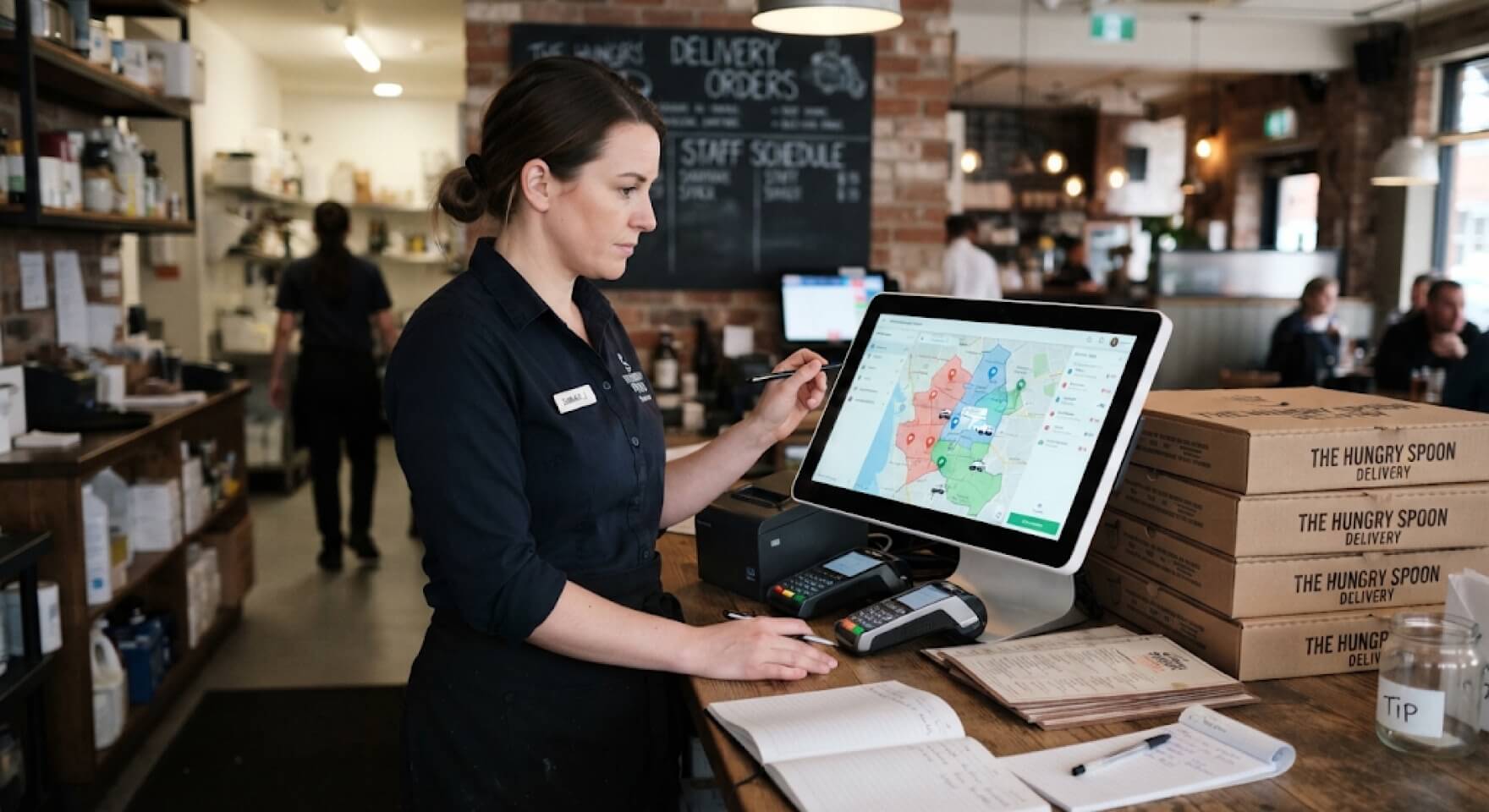
Giving 30-35% of the check to aggregators is deliberately killing your own profitability. To keep the margin inside the business, you need your own service. However, cash gaps start where there is no logistics and drivers work without control. Strict routing, transparent accounting of couriers’ work, and modern courier delivery automation are the only way to profitability. We break down using real numbers how to properly organize food delivery, calculate break-even points, and motivate staff without overpaying.
In Europe, many small businesses are afraid to invest in logistics. But a competent launch of delivery from a restaurant or cafe pays off as soon as the establishment crosses the mark of 30 checks per day. Let’s summarize the economics.
| Metric (average check 20 EUR) | Aggregator (Glovo, Bolt Food) | In-house service |
|---|---|---|
| Commission per order | 30-35% (6-7 EUR) | 0 EUR |
| Driver’s pay (piecework) | 0 EUR | 2-3 EUR |
| Marketing / Acquiring | Included in commission | ~0.50-1 EUR |
| Balance in the register (gross) | 13-14 EUR | 16-17 EUR |
Let’s calculate the break-even point. If the fixed costs of maintaining the staff (car rental, courier service software, communication) amount to 800 EUR/month, and the marginal profit from one order is 4 EUR, you need to fulfill 200 orders per month (about 7 per day). Everything above is your net P&L. Realizing how to organize food delivery from a restaurant properly, many companies abandon intermediaries forever.
When searching for information on how to organize food delivery around the city, restaurateurs often create one broad map with a fixed price. This is a guaranteed loss for the company. The city must be sliced into polygons in the system. Green zone (2-3 km radius) — delivery time up to 30 minutes. Yellow zone (3-5 km) — up to 55 minutes. Red zone — over 5 km, where a courier is sent only with large checks. An optimal division of territories insures against situations where a car drives to the other end of the city for one portion of rolls.
Monetization of the delivery service determines order traffic. The first model is free delivery for everyone, where the cost of logistics is hidden in the food cost. The second is free starting from a certain amount (e.g., from 18 EUR), which is a powerful upselling tool. The third is a mileage fee. A dynamic tariff compensates for fuel costs if the guest decided to order goods to a remote residential area and fully covers the delivery service.
Staff planning depends entirely on the kitchen’s throughput. If a pizza oven can produce 20 pizzas per hour, and one courier makes 2.5 trips in that time, three employees will be enough. Keeping five in the hall is pointless — you will burn money on base rates. Analysis of heat maps shows that proper organization of the food delivery service reduces the payroll fund by 15%. Therefore, it is important to know how to organize a delivery service without inflating the staff.
To avoid generating losses, you need a flexible courier service program that accurately calculates the KPI of each employee.
| Payment model | Operating principle | When to use |
|---|---|---|
| Hourly rate | Fixed amount per hour/shift | At the start of the project to retain staff during low traffic |
| Piecework (per check) | Payment only for completed delivery of goods | High client density (city center), stable flow |
| Mixed (fix + bonus) | Minimum base + fix for each parcel | Ideal balance for scaling the network |
When building logistics, a restaurateur chooses: in-house staff, outsourcing, or working with taxis. You can negotiate directly with taxi fleet drivers for emergency deliveries. Syrve’s practice proves the effectiveness of the hybrid scheme: 70% of the load is covered by full-time employees, and on Friday evenings, the establishment uses the services of two local delivery services. Quick connection of outsourced couriers to the system solves the problem of peak hours.
Minutes are not lost at traffic lights, but in the kitchen. The chef hands over the package, and it sits at the pickup point for 12 minutes because the driver is not there. To speed up the delivery service, a KDS screen is needed in the kitchen. The chef sees the exact arrival time of the employee, preparing the dish precisely for their return. Implemented delivery planning automation synchronizes processes. We detailed all the stages of how automation of order acceptance and processing works in the previous article.
Cash is a chronic pain for an entrepreneur. If couriers are not controlled and they hand over revenue from their pockets at the end of the day, expect shortages. The Syrve system records amounts online: the owner’s dashboard shows the exact balance in the employee’s hands (the POS module works even without the internet). Modern courier service automation allows accepting payments online. If you connect a new service or integrate the ability to accept payments via messengers, you will reduce the circulation of paper money. This technology allows accepting cashless payments and guarantees strict cash discipline.
A good program for couriers (like SyrveWaiter) is a shift control panel. The employee sees an optimized route, location of the house, and has a button to contact clients. After the handover, the delivery confirmation button is pressed, which instantly changes the delivery status in the terminal. If the client took a long time to come down, the system records this, removing the delay penalty from the driver. Additionally, the app includes the ability to pay via the app, allowing the guest to pay by card right at the door, which is very convenient for clients.
The main failure is the lack of digitization. Entrepreneurs who simply organize the delivery of goods turn the establishment into a post office branch, sending goods blindly without analytics. The state postal service delivers goods well, but a restaurant should sell emotion and service.
The second mistake is ignoring the database. A powerful CRM system for the establishment accumulates guests’ preferences. You are not just closing deliveries, you are building relationships with clients. Reliable automation of cafe delivery for an in-house service helps the establishment become independent of monopolistic services. When the owner organizes their own service, they decide for themselves which payment systems to use and how to control the staff. As a result, the profitability of companies grows, and the guest gets hot food on time.