Fiscalization in an establishment: PRRO, online cash register, and POS system integration
28 September 2026
Read
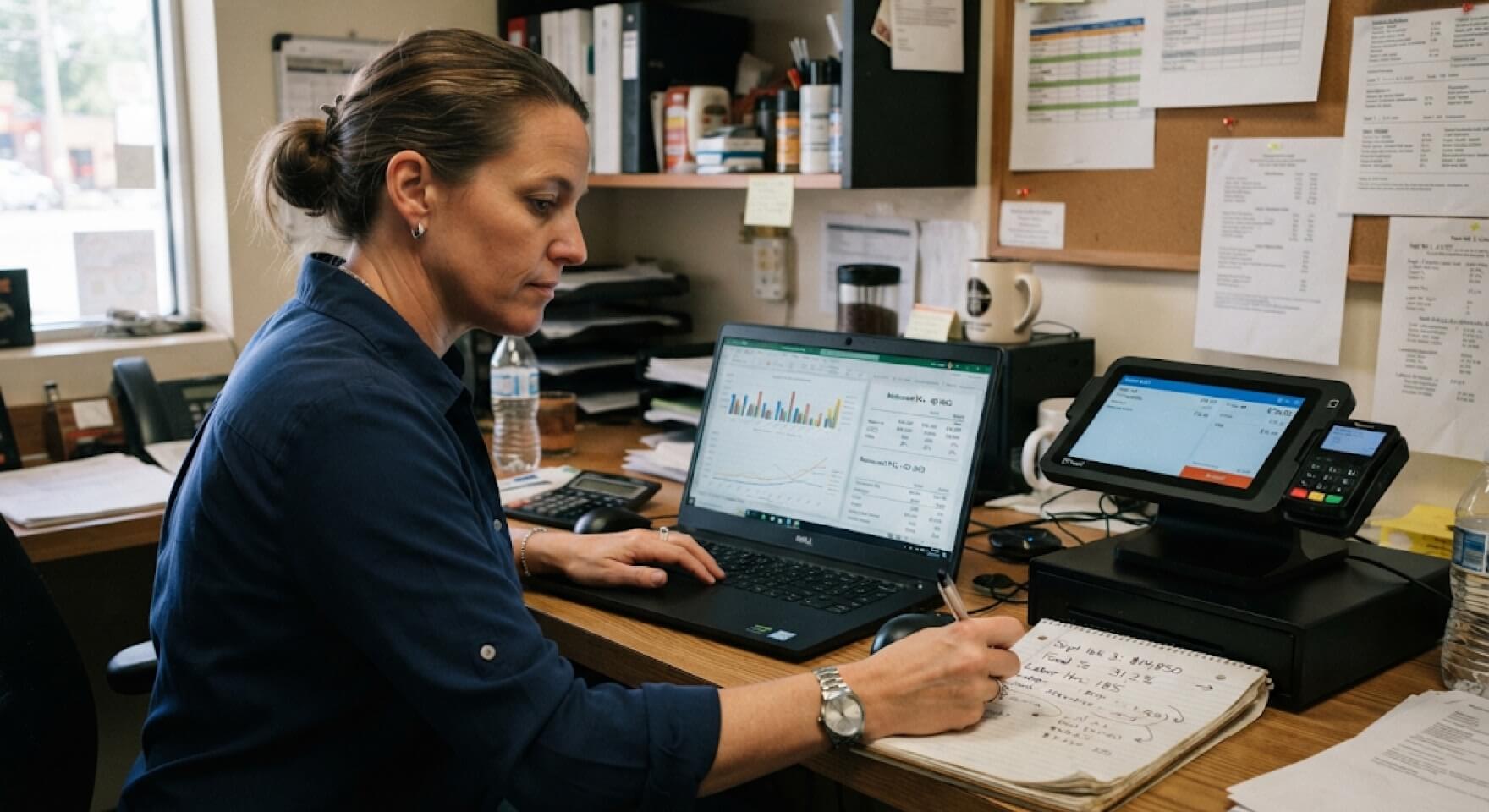
A full house and a daily queue at the entrance absolutely do not guarantee that your business is successful. Many establishments exist on the edge of profitability for years, even though the halls are visibly overcrowded. Guests order expensive steaks, waiters are run off their feet, and clean cash is barely enough to cover current expenses. The main problem in the restaurant business is the cash gap. The owner sees high traffic, but at the end of the month, there are not enough funds for the banal payment of rent.
This financial hole arises due to manual data consolidation and a lack of daily control. The solution is automated restaurant financial reporting. A properly configured financial accounting system allows you to see real income, generate key metrics, and accelerate managerial decision-making based purely on numbers. Spoiler: without a professional POS system and comprehensive software, you imperceptibly lose up to 15% of your revenue.
Money in the cash register is not yet your money. Global revenue is very easily confused with net assets, but it already includes debts to coffee suppliers, taxes, and the chefs’ payroll. Competent restaurant financial management strictly separates these concepts, turning chaotic restaurant finances into a clear structure.
When the owner is only interested in daily receipts, control over real profitability is instantly lost. Modern accounting systems monitor all expenses in detail at every stage — from receiving goods to selling the finished item, gathering precise analytics. You see the net margin.
The Profit and Loss (P&L) report is the main financial report of a restaurant, demonstrating its operational efficiency. Standard general accounting does not work here. P&L is structured around highly specific items: Prime Cost (food cost plus labor cost), operating expenses, taxes, EBITDA, and net profit.
When setting up restaurant accounting from scratch, ensure that each transaction is automatically distributed across these categories. This is a reliable foundation for accounting that objectively reflects the real profits and losses of your establishment. A correct report provides 100% transparency.
Your P&L can be pleasantly positive, but your bank account can be empty. The Cash Flow report demonstrates the dynamics of settlements for operating, investing, and financing activities. You always know the exact source of money. We detailed why a restaurant cannot develop without management accounting in previous materials. Correct payment planning is impossible without strict control of this report.
The cost of dishes is the most dynamic expense item. Reporting must continuously broadcast the food cost weekly, detailing it across dozens of product categories. If the cost of a specific type of fish suddenly jumps, you see it instantly. This allows you to quickly reduce the portion or change the recipe. Regular verification of this metric is the best tool for retaining margin.
The payroll fund ruthlessly eats up to 25% of the profit. To objectively assess the productivity of employees, it is not enough to know the general cash receipts. It is important to analyze revenue per person per hour. The use of mobile waiter terminals cuts order processing time in half. Proper staff optimization significantly increases the efficiency of the hall, and you see the KPI of each employee online.
Studying the average check shows how much money your guests leave. However, depth is much more important — the number of items in a single order. Marketing prompts on the POS terminal help significantly boost this metric. A detailed sales analysis allows you to accurately determine the performance of marketing campaigns. You know exactly which offer works better.
Inventory blind spots generate the harshest losses. The write-off document records food spoilage and expiration. A constant process of monitoring discrepancies during inventory checks reveals internal theft. In a professional program, accounting is automated, covering various inventory aspects. When a chef serves a dish, the comprehensive accounting system instantly writes off ingredients, minimizing the human factor.
To maximize profitability, you need to identify menu drivers. Menu ABC analysis competently divides dishes by sales volume and net margin. You clearly understand which items should be actively promoted and what urgently needs to be optimized or removed forever. By analyzing data, you make firm decisions.
To effectively manage the system based on facts, a management rhythm is needed. Daily, we check the cash register and the number of guests. Weekly, we consolidate Cash Flow and evaluate manager performance. Monthly, we generate final reports. Study restaurant management accounting: 7 tips for setting up these processes. The owner must see these metrics from their smartphone at any moment.
How to quickly understand if the financial metrics of a cafe are normal? For a classic establishment, food cost is 25–30%. Labor cost — no more than 25%. Rent — up to 10-12%. If your numbers exceed these red lines, strict steps for process optimization are needed. Accurate analytics provide a solid base for increasing the profitability of a restaurant of any format.
Compiling tables manually at night is a path to fatal errors. Modern restaurant management accounting requires a single digital platform. Choose reliable management accounting software. The advanced Syrve restaurant automation system unites the cash register, inventory, and finances in one shared solution. All accounting functions in the restaurant work completely seamlessly.
Professional restaurant management automation with Syrve ensures that terminals continue to work and accept orders even without the internet. The POS automatically fiscalizes sales, and the integrated delivery module quickly and flawlessly processes delivery orders. Thanks to this program, you get a 100% transparent picture of the restaurant’s operations. All reports are generated automatically in two clicks. This completely frees up your time to search for new business opportunities instead of the routine consolidation of endless columns of numbers.