Fiscalization in an establishment: PRRO, online cash register, and POS system integration
28 September 2026
Read
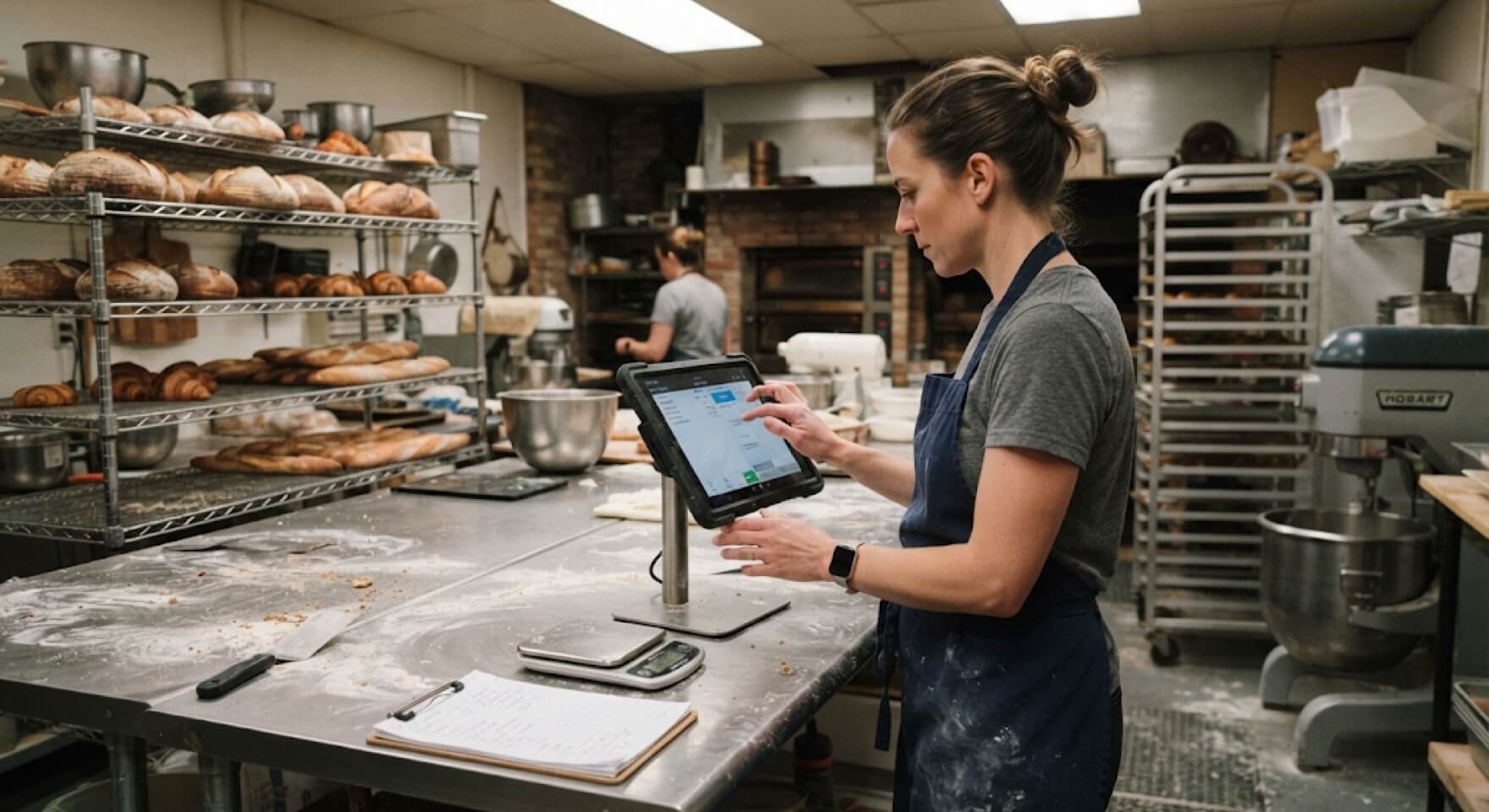
Every day, up to 15% of revenue goes into the trash if the owner does not control the production cycle. Unaccounted flour losses, leftover croissants from yesterday, and chaos in pre-orders eat up the margin. Comprehensive bakery automation and end-to-end accounting help solve this problem. A properly configured system records every gram of raw materials, reduces food costs, and turns business blind spots into a transparent P&L report.
A coffee shop mostly resells goods, whereas a bakery transforms raw materials into a new product. It is a full-fledged production workshop. Restasystem experts often encounter situations where entrepreneurs try to keep bakery records like regular retail. This leads to a 20% discrepancy during audits.
To avoid cash gaps, you need professional automation for bakeries and niche establishments that takes into account the complexity of the processes. Accounting software should process not only final sales but also purchases from suppliers, so you can track the movement of assets at every stage.
Baking consists of several stages. For example, a croissant is not just flour and butter. It involves kneading the dough, forming a semi-finished product, freezing, and baking. Multi-level technological routingings are created for such complex chains. Modern software allows you to specify the percentage of thermal processing loss for all ingredients. When the cash register rings up a finished product, the accounting system automatically breaks it down to its basic components.
Semi-finished products (frozen dough, prepared creams) can be stored in the warehouse for days. If you do not set up strict inventory accounting in a restaurant and cafe, you will never know where 10 kg of sugar disappeared. Production accounting in a bakery records the movement of preparations between workshops. Bakery automation allows you to see the real balances not only of raw materials but also of unsold semi-finished products in the refrigerators.
Product write-offs can occur upon sale or upon preparation. In large-scale pastry shops, production reports are more often used. The cook registers the output of a finished batch on the KDS kitchen screen, and the pastry shop software instantly writes off the ingredient consumption from the warehouse. This makes shortages or misgrading impossible, as the pastry shop automation system works in real-time.
A drop in profitability often hides in an excess of unsold products. Syrve analytics help optimize baking volumes using ABC analysis and demand forecasting based on past period statistics. Thanks to this, the bakery POS becomes a planning tool: you know that at 4:00 PM you need to bake 20 more baguettes because that is when peak customer traffic arrives.
No accounting automation guarantees zero balances. However, competent product accounting and inventory control allows minimizing losses. In the evening hours, the system can automatically apply discounts to the showcase, updating electronic price tags for pastries. If baked goods remain, the bakery automation software writes them off or transfers them to raw material status (for example, for making breadcrumbs or pastry bases).
Working with custom cakes requires strict discipline. Pastry production accounting must integrate with the CRM module. Upon receiving an order, the administrator records the prepayment, delivery dates, and special requests in a single interface. Individual calculation of pastries allows immediately calculating the cost of non-standard decor, maintaining a stable margin level.
Many bakeries operate in a B2B format, supplying desserts to other establishments. The Syrve comprehensive automation program easily separates retail sales and wholesale shipments by invoices. You can set up different price lists for different contractors. Such management and control allow maintaining a single database where wholesale sales do not get mixed up with ordinary customer receipts.
The true cost of a croissant includes the percentage of boil-off and losses during defrosting. The accounting system automatically calculates these indicators based on regular inspection data. For the numbers to always be accurate, regular and fast cafe inventory is required, which is easy to conduct via electronic forms on a phone. The owner can see the up-to-date food cost on a mobile dashboard at any time.
To simplify workflows, you do not need to buy servers right away. The Syrve Cloud mini-bakery software can be deployed in a few hours. The basic functionality includes a POS terminal (POS works even without the internet), an inventory module, basic analytics, and raw materials accounting. Reliable accounting software is an investment that pays off in the first months of operation by eliminating theft and reducing product write-offs. To automate your business without errors, entrust the setup and staff training to professional integrators.